
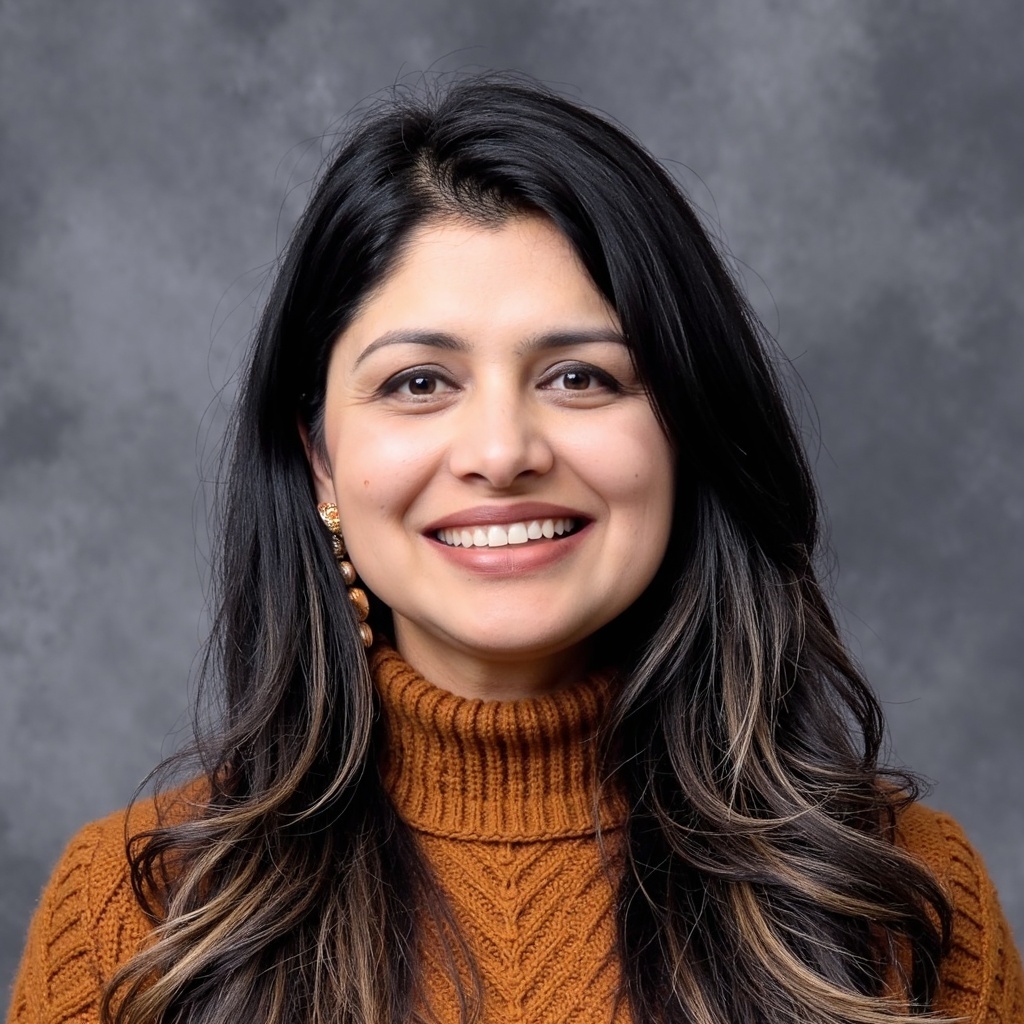
In a world racing toward automation, artificial intelligence, and algorithmic efficiency, Shikha Bajaj has spent more than 25 years asking a quieter and more demanding question: what does this mean for the person on the other side?
That question has shaped every strategy she has built, every team she has led, and every system she has transformed. As Founder of Own Your Color and a globally recognized leader in digital and healthcare transformation, including a 2025 Global Recognition Award, Shikha has built a career at the intersection of data, execution, and deeply human leadership. But what defines her work is not transformation for its own sake. It is transformation that feels human. Healthcare that listens. Systems that see people, not just patients.
“Technology only matters when it improves decisions that impact human life,” she says simply. In an industry that often loses sight of that truth, she has made it her compass.
THE PATTERN THAT REFUSED TO BE IGNORED
Shikha’s leadership philosophy was not formed in a classroom or a boardroom. It was formed in the gap between what systems promised and what people actually experienced.
Early in her career, she noticed a pattern repeating itself across organizations. Systems were becoming more sophisticated. People were feeling less seen. That tension, present in healthcare environments where the stakes of invisibility are highest, never left her. It evolved instead into a guiding principle that now anchors everything she does: clarity is leadership, empathy is execution, and sustainable transformation only happens when both coexist.
It is also the founding insight behind Own Your Color, a global movement built on the belief that people do not need to fit into systems. Systems must evolve to reflect people.
“This is where Own Your Color was born,” she reflects. “From the idea that authenticity, mentorship, and human-centered transformation can scale across organizations and cultures.”
DATA AS EMPATHY IN MOTION
Few leaders have done more to reframe the conversation around data-driven decision making than Shikha. In an era where dashboards have become destinations and metrics have become endpoints, she insists on a fundamentally different relationship with information.
“Data is not the answer,” she says. “It is the language. But meaning comes from interpretation.”
Her approach consistently connects numbers back to the human moments they represent. What does this metric mean for a patient waiting for care? What does this delay mean for a clinician making a critical decision under pressure? These are not rhetorical questions. They are the filters through which strategy becomes human again, and data becomes, as she puts it, empathy in motion.
This is what separates insight from information, and transformation from mere optimization.
AGILITY WITH ACCOUNTABILITY
In healthcare environments defined by multiple stakeholders, competing priorities, and high-consequence decisions, agile methodology is frequently misunderstood. Speed is treated as the point. Shikha disagrees.
“In healthcare, agile is not about speed,” she says. “It is about structured adaptability.”
Her approach integrates clinical, technical, and business teams into alignment from the very beginning, so that collaboration starts with shared understanding rather than handoffs and miscommunication. She places particular emphasis on something the agile conversation too often overlooks: discipline. Agility without governance creates chaos. Agility with structure creates trust.
The philosophy is straightforward, and it is one she returns to consistently across complex transformation programs: move fast, but never disconnect from responsibility.
OUTCOMES PATIENTS FEEL, NOT JUST SYSTEMS REPORT
For Shikha, the relationship between business goals and patient-centered outcomes has never been a tension to manage. It is a false separation to dissolve.
When healthcare systems genuinely improve, access improves. Experience improves. Trust improves. And when trust improves, outcomes follow in ways that no dashboard alone can fully capture. She consistently steers client conversations away from milestone tracking and toward a more meaningful measure: does the patient feel this transformation?
“Transformation is only successful when patients feel it,” she says, “not just when systems report it.”
That reframe changes everything about how strategy is designed, how success is defined, and how teams stay accountable to what actually matters.
LEADING THE HUMAN WAY
The strongest teams Shikha has led are not the ones that moved fastest. They are the ones that felt most aligned. That distinction is central to how she understands leadership in high-stakes healthcare environments where urgency is real and emotional intelligence is not a luxury but a precision instrument.
She anchors her leadership approach on three pillars: trust built through transparency, consistency in decision-making, and listening that goes beyond hierarchy. Across every transformation program she has led, the pattern holds. Real impact arrives when people feel heard, and when systems are designed around lived human experience rather than operational efficiency alone.
Empathy, in her framework, is not soft leadership. It is the most precise tool available.
OWN YOUR COLOR: LEADING AS YOURSELF
At the heart of Shikha’s global mentorship work is a belief that has become both a personal philosophy and a movement. People lead best when they lead as themselves.
Through Own Your Color, she has created ripple effects across continents, empowering individuals through mentorship, storytelling, and her M.E.N.T.O.R. philosophy to reconnect with identity, purpose, and confidence. The work is not about building compliant professionals. It is about building whole leaders.
“It is not about fitting in,” she says. “It is about showing up fully as who you are.”
THE DECADE AHEAD
Looking at the next ten years, Shikha sees convergence as the defining force: AI, data, personalization, and ecosystem care reshaping healthcare from the ground up. But she is clear about where the real transformation will live.
“The most important shift is not technological,” she says. “It is emotional.”
The organizations that will win are not those that automate the most. They are those that humanize the most, using technology to deepen trust rather than dilute it, and building predictive and preventive models that feel like care rather than surveillance.
Healthcare, for Shikha Bajaj, has never been a system problem. It is a human promise. And when leadership is grounded in empathy, data becomes insight, execution becomes clarity, and transformation becomes something far more meaningful than efficiency.
It becomes care that can be felt.
That is where real change begins.
More About Shikha