
The Pivot Point: Evaluating Royal Mail’s Survival in a Digital-First Economy
For the modern C-suite, Royal Mail has long served as both a critical infrastructure partner and a cautionary tale of legacy scale meeting digital disruption. As we move through the first half of 2026, the organization’s trajectory offers a high-stakes case study in operational restructuring, regulatory lobbying, and the aggressive pursuit of a “parcel-first” identity.
For leadership teams across retail, logistics, and financial services, understanding the current state of Royal Mail—now operating under the International Distribution Services (IDS) umbrella—is essential for risk management and strategic planning.
The Financial Reality: Efficiency vs. Heritage
The core challenge for IDS remains the financial “drag” of the Universal Service Obligation (USO). Historically, Royal Mail was legally mandated to deliver letters six days a week to every UK address for a uniform price. In an era where addressed letter volumes have plummeted—down roughly 10% year-on-year in late 2025—this model became a fiscal sinkhole.
Ofcom estimates the net cost of complying with the current USO at between £325 million and £675 million annually. To counter this, 2026 marks the critical implementation phase of the “five-day, alternate-day” model for Second Class letters, a hard-won regulatory concession. For C-suite observers, the lesson is clear: even a national monopoly must eventually trade legacy service levels for balance sheet sustainability.
The “Parcel-First” Pivot: By the Numbers
The 2025/26 fiscal updates highlight a significant divergence in revenue streams. While letter revenues remain flat or declining, the parcel sector is the engine of growth.
- Parcel Volume Growth: Royal Mail reported an 8% increase in parcel volumes in the most recent quarter, driven by a surge in B2C e-commerce.
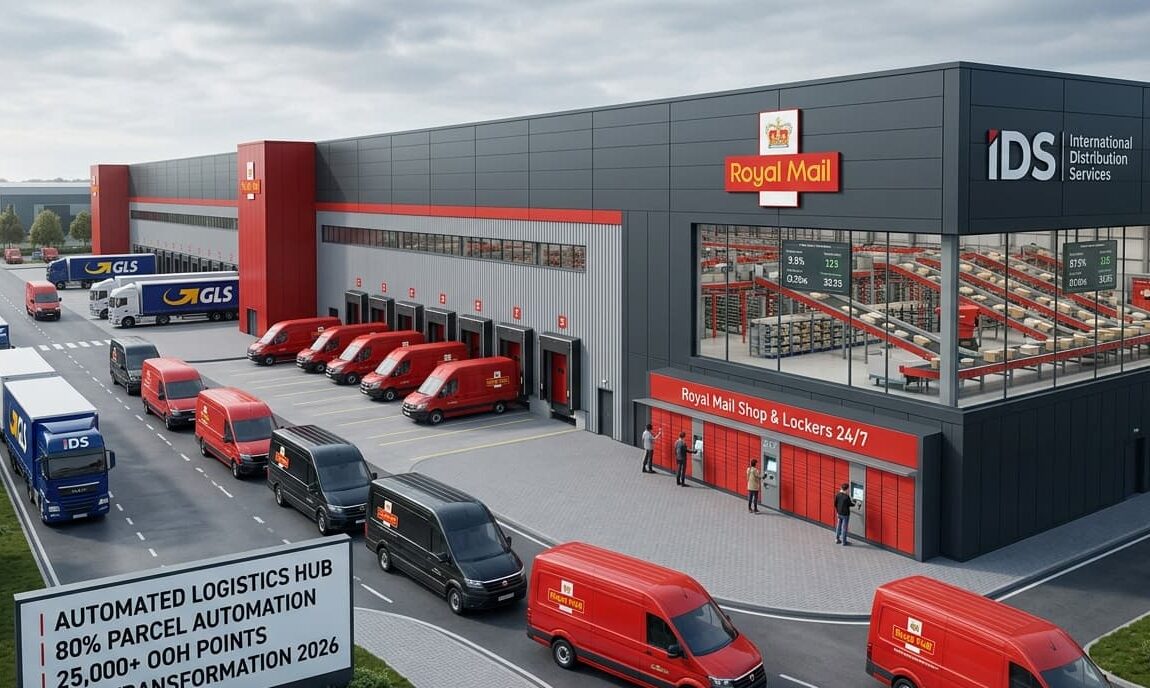
- Out-of-Home (OOH) Expansion: The company has aggressively expanded its “Royal Mail Shop” and locker network, reaching over 25,000 parcel points as of early 2026. This is an 80% increase in lockers compared to 2024.
- Automation: Approximately 80% of parcels are now processed through automated sorting centers, up from just 12% five years ago.
For businesses, this shift signifies a move away from the “postman” and toward a high-tech logistics competitor capable of rivaling DHL or Amazon Logistics.
Strategic Risks: Labor and Regulation
Despite technological gains, two primary risks remain on the executive radar:
- Labor Relations: The transition to a new delivery model has required “intense” negotiations with the Communication Workers Union (CWU). In early 2026, IDS moved these discussions into the Achieving National Agreement Procedure, a formal framework designed to prevent the crippling strikes seen in previous years.
- Quality of Service (QoS) Targets: Royal Mail has struggled to meet Ofcom’s stringent targets. While 99% of items arrived on time during the 2025 Christmas peak, First Class next-day delivery targets (93%) remain a challenge, hovering closer to 77-80%.
The Global Perspective: The GLS Factor
It is a common misconception in the UK that IDS is solely Royal Mail. For global C-suites, the true value often lies in GLS, the international arm of the group. GLS consistently delivers higher margins than the UK domestic business, with parcel volumes growing at 9% and revenue increasing by 8.7% in the latest cycle.
In many ways, GLS acts as the “growth engine” that subsidizes the “modernization engine” of Royal Mail. This diversified structure has allowed IDS to remain a viable investment prospect even during periods of domestic turmoil.
Executive Takeaways for 2026
- Diversify Last-Mile Strategy: While Royal Mail’s locker network is expanding, QoS inconsistencies in the “Letter-Parcel” hybrid model suggest that high-value B2C shippers should maintain a multi-carrier approach.
- Monitor the USO Reform: The shift to alternate-day Second Class delivery will change how billing and physical marketing (direct mail) reach consumers. CFOs should audit mailing schedules to align with these new delivery rhythms.
- Leverage OOH Networks: The massive 80% growth in lockers and shops indicates a permanent shift in consumer behavior. Businesses should integrate “Click & Collect” and locker-drop returns into their digital storefronts to meet this demand.